
When a tooth is damaged beyond what a filling can fix, or when you’re missing a tooth altogether, it affects more than just your smile. Chewing becomes awkward. Nearby teeth start to shift. Over time, your bite changes in ways that can create new problems. That’s where dental crowns and bridges come in. They’re two of the most reliable tools we have for restoring both function and appearance. And while they’re often mentioned together, they serve different purposes.
Let’s break down what each one does and when we recommend them.
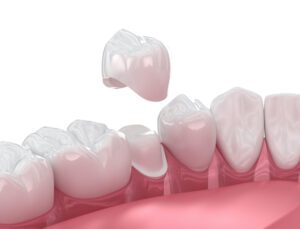
What a Dental Crown Does
A dental crown is a cap that fits completely over your natural tooth. It covers the entire visible portion, from the chewing surface down to the gumline. Think of it like a helmet that protects and strengthens a tooth that has been weakened.
We recommend crowns in several situations:
- When a tooth has a large cavity that a filling can’t safely handle, a crown holds everything together.
- When a tooth fractures, a crown prevents the fracture from getting worse.
- After a root canal, a crown protects the tooth from breaking down the road.
- For teeth that are severely worn from grinding, crowns can rebuild their shape and height.
The process takes two appointments with us. At the first, we numb the area and shape the tooth, removing just enough enamel to make room for the crown. We take impressions and send them to a lab where skilled technicians fabricate your custom crown. You leave with a temporary crown that protects your tooth while the permanent one is being made.
At the second appointment, we remove the temporary crown, check the fit and color of the permanent one, and bond it in place. When we’re done, you could have a tooth that looks natural and functions like the real thing.
What a Dental Bridge Does
A bridge does exactly what it sounds like. It bridges the gap left by one or more missing teeth. The restoration includes replacement teeth in the middle with crowns on either side. Those crowns attach to the teeth adjacent to the gap, anchoring the whole bridge in place.
Bridges are a good option when you have healthy teeth on both sides of a gap. Those neighboring teeth become the support system for your new restoration.
Like crowns, bridges require two appointments. We prepare the anchor teeth, take impressions, and fit you with a temporary bridge. At the second visit, we place your permanent bridge and make any necessary adjustments.
Crowns and Bridges Work Together
The connection between crowns and bridges is simple. A bridge uses crowns on the teeth next to the gap to hold the replacement teeth in place. So when you get a bridge, you’re also getting crowns on the teeth that anchor it.
Both restorations are made from durable materials like porcelain or ceramic that match your natural tooth color. No metal showing. No dark lines at the gumline.
How Long They Last
With good care, crowns and bridges typically last 10 to 15 years. The restorations themselves won’t decay, but the teeth underneath still can. That’s why we emphasize regular brushing, flossing, and keeping up with your dental cleanings.
We also recommend flossing around bridges carefully. Food can get trapped underneath the replacement teeth, and plaque can build up around the anchor teeth. Floss threaders or water flossers help make this easier.
A Natural Look and Feel
Our patients often tell us they forget their crown or bridge is even there. Modern materials look and feel like natural teeth. You could eat normally, smile confidently, and speak without worrying about gaps or worn-down teeth.
If you have a tooth that’s been bothering you or a gap you’ve been hiding, crowns or bridges might be the answer. Our team at AH Smiles serves patients from Arlington Heights, Buffalo Grove, Long Grove, Deerfield, and Northbrook. Give us a call. We’ll take a look and help you figure out what’s right for your smile.